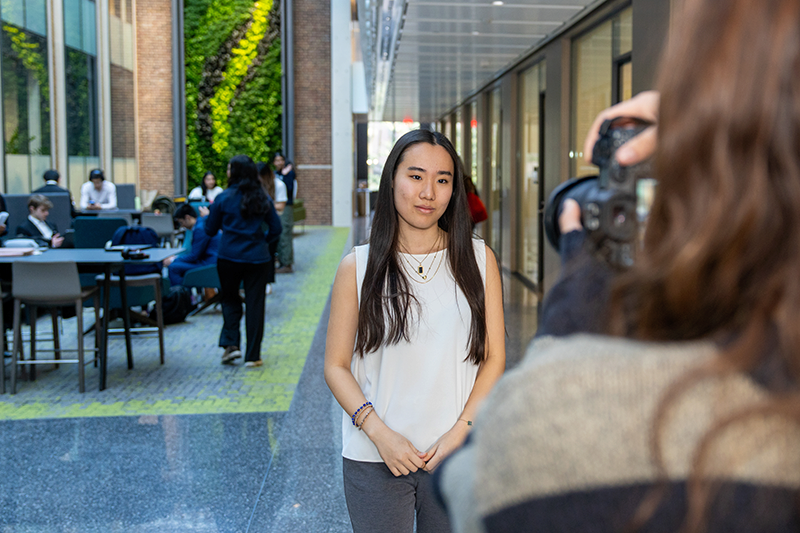


Contrary to stereotypes, it’s uncommon to find first-year undergraduates walking through campus wearing suits. On Fridays, it’s more likely they’re sitting on blankets in the Quad or chatting over a latte outside of Huntsman Hall’s coffee shop. But, this past February, 90 first-years headed to the Academic Research Building in their nicest professional attire.
That Friday marked the final session of Career Readiness @ Wharton, an Undergraduate Division program developed with the Wharton Dean’s Undergraduate Advisory Board (WAB) to help first-years understand the breadth of industry exploration and prepare for the internship-search process.
The four-week program included presentations on common and niche careers, resume and cover letter workshops, and training in soft skills for interviews and outreach. The last session featured mock interviews conducted by MBAs and alumni, as well as a networking reception.
Career Readiness was piloted in 2024 with 50 first-years. It officially launched in 2025 with 90 participants, with the goal to continue expanding each February.
WAB members Lizzie Guan, W’25, and Caroline Keswin, W’25, helped create the program based on their past internship and job-search experiences.
“The biggest thing that we’re trying to articulate is that no recruiting process is the same,” Caroline said. “Everyone goes through their own struggles, obstacles, and successes.”
The program was strengthened by including third- and fourth-years who had just finished their internship- and job-search processes.
Each first-year was paired with a learning assistant (LA), upper-level students with internship and employment experience across a variety of industries. Many LAs said they were offering what they would have liked for themselves.
“I [was] able to talk to people who were once in my shoes, who have a genuine story that compares to mine and taught me steps they wish they had taken,” said participant Addison Saad, W’28.
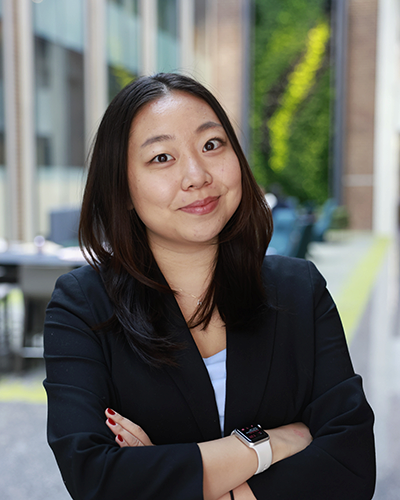
Learning assistant Haerin So, W’25, used her experiences across investment banking, private equity, research, and consulting to help first-years understand what working in different industries actually entails.
“Time has gone by so fast. I haven’t really taken the time to think about what I wish I could have told my first-year self, but I’ve grown to be a little more candid,” she said.
At Wharton, everybody understands the concept of “paying it forward” and is willing to help undergraduates seeking advice. Iian Chen, W’28, said that was a major reason he chose Penn.
“I’ve talked to industry professionals who stress the importance of mentorship,” the Atlanta native said. “Mentorship is just something that’s part of Penn culture.”

The LAs fulfilled a unique need for students: candor and honesty about their failures, according to Haerin. Addison, a first-year at the time, agreed.
“I see these people as a casual resource,” she said. “I feel like I can ask questions that I’m scared to ask other people at Penn.”
The Houston native mentioned that the LAs’ frankness about failure helped her see them not only as resources but as friends.
Haerin saw that as a highlight of her relationship with the first-years: “You only really get this vulnerability when you’re assigned peer-to-peer mentors.”
“I [was] able to talk to people who were once in my shoes, who have a genuine story that compares to mine and taught me steps they wish they had taken.”
Throughout that Friday in February, first-years walked in and out of rooms in the Undergraduate Division. They left excited, whispering among themselves: How’d it go? Was he scary? It can be hard to remember these are only mock interviews, but the program aims for authenticity.
The interviewers — MBA students and recent Wharton alumni — are eager to assist. Jordan King, W’21, a consultant at Deloitte in Philadelphia, attributes his continued involvement with Wharton to his own mentorship at Penn through programs like the Successful Transition and Empowerment Program (STEP). He noted that interviewees were “very polished and well prepared.”
“A lot of the applicants I interviewed today showed great vulnerability and maturity,” Jordan recalled. “That’s something that even somebody like myself, who might be more experienced, needs to remember to be empowered in terms of being more open and transparent.”
Jordan looked both nostalgic and hopeful as he continued, reminded of how much can be accomplished at a young age. “It’s a reaffirmation, a reminder for someone as myself, who’s not very far in my own career, just to remember how much and how many ways that I’ve impacted people.”

A helpful aspect for participant Iian was the first session, which required reflecting on personal values and exploring which careers align with those.
That reflective quality continued as he spoke with alumni on the final day: “They stress where you start — it’s definitely not a linear path to where you end up wanting to be,” he said. “It’s something to consider when choosing what career to go into initially.”
The recruiting cycle is often marked by confusion — conflicting deadlines and timelines among companies, as well as a paralyzing number of career opportunities. The Career Readiness @ Wharton program was started to help students feel more prepared. However, it has also helped students better understand the job-search process by focusing on opportunities for authenticity and aspiration, and to think of networks as real human connections.
— Alex Zhou, C’25, W’25
Posted: December 8, 2025