


At the 2025 Wharton Climate Prof event, faculty members had just five minutes to present their latest research at the intersection of business and climate change. …Read More
At the 2025 Wharton Climate Prof event, faculty members had just five minutes to present their latest research at the intersection of business and climate change. …Read More

(Outlet: Kleinman Center for Energy Policy) How effective are improved cookstoves subsidies? Using a randomized trial in Nairobi that accounts for additionality and impact, we estimate a cost of $7 per ton of CO₂e, making them more effective than nearly all other climate subsidies. Each dollar of cookstove subsidy abates approximately 200 times more CO₂e than a dollar of electric vehicle subsidy.…Read More

(Outlet: Penn Today) R. Jisung Park, an assistant professor in the School of Social Policy & Practice with a secondary appointment in the Wharton School, discusses climate change and the impact of extreme heat on academic success and worker productivity.…Read More

(Outlet: Penn Today) To better understand the impact of Hurricane Ida on Philadelphia, an interdisciplinary research team from the University of Pennsylvania has developed a high-resolution model, paving the way for better forecasting to mitigate damage as extreme weather events become more common.…Read More

(Outlet: Wharton Magazine) Scholars, including Sanya Carley, who leads Penn’s Kleinman Center for Energy Policy and is an affiliated scholar of the Climate Center, examine the implications of the data-center boom for land use, energy, and the environment.…Read More

As a ClimateCAP Fellow and WISC Team Lead, Wharton MBA Kenneth Xu is exploring how finance, policy, and innovation can work together to drive scalable climate solutions.…Read More

Wharton is pleased to welcome 13 new faculty members this year. Parinitha (Pari) Sastry brings expertise in climate change, housing, and insurance markets.…Read More
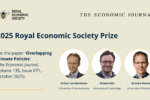
(Outlet: Royal Economic Society) The Royal Economic Society (RES) is pleased to announce that the 2025 Royal Economic Society Prize has been awarded to Grischa Perino, Robert Ritz, and Arthur van Benthem for the article ‘Overlapping Climate Policies’.…Read More

(Outlet: Penn Social Policy & Practice) When carefully designed and supported by thoughtful public policy, markets can play a meaningful role in helping communities effectively and efficiently manage the risks of climate change, according to a new article coauthored by Dr. R. Jisung Park. Dr. Park is an assistant professor at Penn’s School of Social Policy & Practice (SP2) with a secondary appointment at the Wharton School.…Read More

The 2024 Wharton Climate Prof packed evidence-based insights into short time slots, giving faculty just five minutes to present their latest research at the intersection of business and climate change.…Read More